

At electricity prices in force from 1 November 2026 and Enbridge’s EGD-zone gas rates from 1 October 2026, a 96 percent gas furnace costs less to run over a whole winter than an air-source heat pump on Ontario’s Tiered and Time-of-Use plans. On Ultra-Low Overnight on a Toronto Hydro bill, between 11 p.m. and 7 a.m., the heat pump comes out ahead down to about -8.3°C in published example figures for two specific ducted units, not a market survey. So in the heat pump vs furnace decision, the electricity price plan moves the answer more than the equipment does.
That is no case against cold-climate heat pumps, which are the better buy in some GTA homes. It is a case for pricing the plan before you price the machine, using your own gas and hydro bills. Both halves of the answer rest on one number: the coefficient of performance, or COP, that a heat pump has to hold on your plan to match gas.
Heat Pump vs Furnace: The Short Answer for a Gas-Serviced GTA Home
Against a 96 percent gas furnace, at Ontario electricity prices effective 1 November 2026 on a Toronto Hydro bill and Enbridge EGD gas rates effective 1 October 2026, each electricity plan sets a different bar for a heat pump to clear.
- On the Tiered plan in a winter month, at 1 November 2026 electricity prices on a Toronto Hydro bill and 1 October 2026 EGD gas rates, a heat pump has to hold a COP of 4.2 on the first 1,000 kilowatt-hours and 4.8 above that to match gas. In published example figures for two specific ducted units, not a market survey, only one of the two reaches either bar, and only in mild weather. Over a whole winter on Tiered, a 96 percent gas furnace costs less to run.
- On Time-of-Use in winter, at 1 November 2026 electricity prices on a Toronto Hydro bill and 1 October 2026 EGD gas rates, a heat pump has to hold a COP of 3.6 off-peak, 5.2 at mid-peak and 6.5 in weekday on-peak hours to match gas. In published example figures for two specific ducted units, not a market survey, 3.6 is reached only in mild weather, and 5.2 and 6.5 are never reached. Over a whole winter on Time-of-Use, a 96 percent gas furnace costs less to run.
- On Ultra-Low Overnight between 11 p.m. and 7 a.m. every day, at 1 November 2026 electricity prices on a Toronto Hydro bill and 1 October 2026 EGD gas rates, a heat pump only has to hold a COP of 2.0 to match gas. In published example figures for two specific ducted units, not a market survey, both clear 2.0 down to about -8.3°C, making the heat pump the cheaper machine in those hours; at about -15°C only one of those figures still clears it. The plan’s weekday bar from 4 p.m. to 9 p.m. is 12.2.
Across Tiered and Time-of-Use, at 1 November 2026 electricity prices and 1 October 2026 EGD gas rates, the bar runs from 3.6 to 6.5, and the one to judge those plans by is the lowest, 3.6. A heat pump that cannot hold 3.6 in the hours it runs cannot beat gas in any hour on those two plans, because every other bar on them is higher.
The rate plan changes the answer more than the equipment does.
Why You Cannot Compare a Cubic Metre to a Kilowatt-Hour
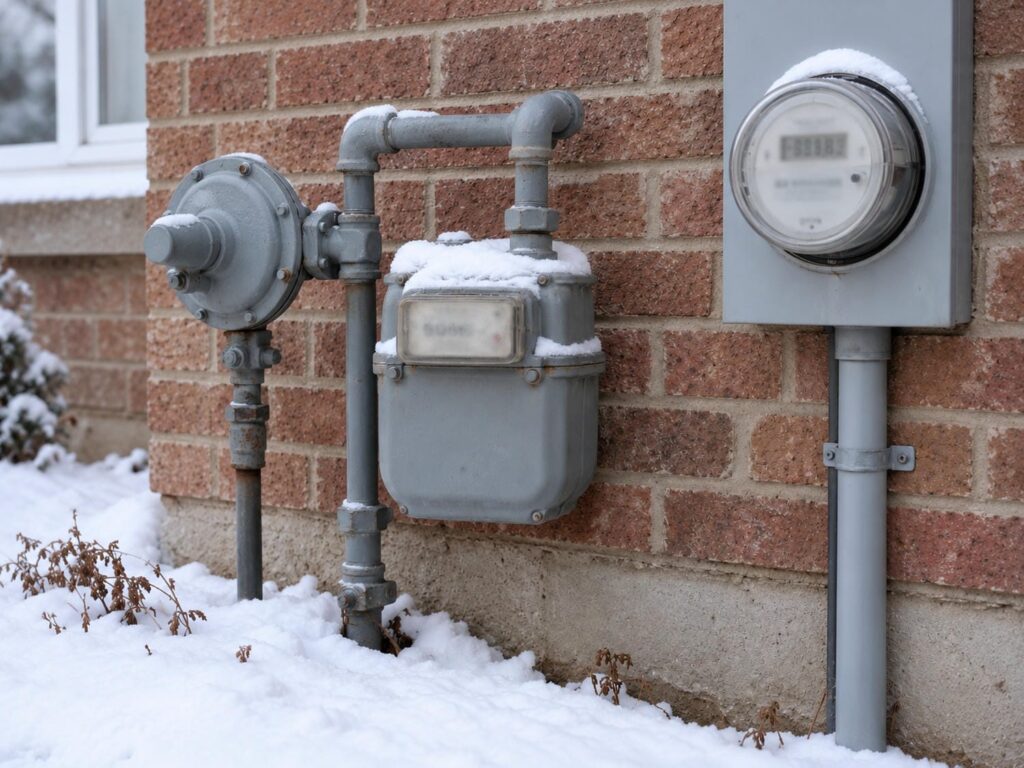
Put a cubic metre of gas beside a kilowatt-hour of electricity and gas looks about twice as expensive: with HST, a cubic metre above the first 170 in a winter month costs about 31 cents at the EGD gas rates from 1 October 2026, against about 15 cents for a kilowatt-hour above 1,000 in a winter month on the Tiered plan, on a Toronto Hydro bill, from 1 November 2026. Those two units do not hold the same amount of heat. Count instead per unit of heat a 96 percent furnace actually delivers into your ducts, and gas at those 1 October 2026 rates costs about a fifth as much as that kilowatt-hour, which is the gap a heat pump’s efficiency has to close.
A Furnace Makes Heat, a Heat Pump Moves It
A furnace burns fuel, and it can never return more energy than it bought. A heat pump runs a compressor and delivers two to four times the energy it bought, because it moves heat that already exists outdoors instead of creating it, and in summer the same outdoor unit runs in reverse to cool the house. That ratio of heat delivered to electricity bought is the COP, and it falls as the outdoor temperature drops. So the comparison is not obvious, and it genuinely flips with local prices.
The Only Fair Unit: Cost per Kilowatt-Hour of Heat in Your Ducts
Cost per kilowatt-hour of delivered heat is what one kilowatt-hour of warmth arriving in your ducts costs you, once the machine’s losses or gains are counted. For gas, it is the delivered price of a cubic metre divided by the useful heat left in that cubic metre after the furnace’s losses. For a heat pump, it is the delivered price of a kilowatt-hour divided by the COP at the moment the unit is running. A cubic metre of natural gas holds about 37.3 megajoules, which is 10.36 kilowatt-hours, because a kilowatt-hour is 3.6 megajoules. Burned in a 96 percent furnace, a cubic metre delivers about 9.9 kilowatt-hours of heat into the ducts.
That 96 percent is the furnace’s AFUE rating, and condensing gas furnaces run between 90 and 98 percent. Federal law has required a new gas furnace to be 95 percent or better since July 2019, so 96 percent is a realistic figure for a unit someone would install today rather than a flattering one. Above that legal floor, what an AFUE rating actually buys you is a furnace-shopping question, and it barely moves the comparison with a heat pump.
What Natural Gas Actually Costs to Burn in the GTA
On the cubic metres above the first 170 in a winter month, at the EGD rates effective 1 October 2026, the gas supply line is only about a third of what you pay. Quoting it alone understates the gas side badly. Enbridge bills a GTA home for the gas, for transporting it and for delivering it, and all three lines rise with every cubic metre burned.
The Gas Supply Line Is About a Third of Each Cubic Metre
At the EGD rates effective 1 October 2026, once the quarterly cost adjustment is counted, gas supply comes to 9.1080 cents a cubic metre, transportation to 5.8452 and delivery to 12.8199 on the over-170-cubic-metre winter block, which totals 27.7731 cents a cubic metre before HST. The delivery line alone costs more than the gas itself. The first 30 cubic metres each month bill at a higher delivery rate, but a GTA house heating with gas in winter sits in the over-170 block, so that block prices each extra cubic metre of heat.
Divide those 27.7731 cents by the 9.9456 kilowatt-hours of heat a cubic metre delivers in a 96 percent furnace, and gas on the over-170-cubic-metre winter block at the 1 October 2026 EGD rates works out to about 2.7925 cents per kilowatt-hour of delivered heat before HST, or about 3.16 cents with HST. Rounded to 2.79 cents before HST, that is the figure a heat pump has to beat in the EGD zone.
The Federal Carbon Charge on Gas Has Been Zero Since 1 April 2025
Gas used in Ontario since 1 April 2025 carries no federal carbon charge, and Enbridge’s EGD residential rate schedule effective 1 October 2026 still lists the charge at 0.0000 cents a cubic metre. From 1 April 2024 to 31 March 2025, that charge was 15.25 cents on every cubic metre, before HST. Its removal is why a heating-cost comparison written before 1 April 2025 no longer describes your bill. A much smaller facility carbon charge does remain, folded into the delivery line, so the zero applies to the federal carbon charge itself.
Your Rate Zone Changes the Shape of Your Bill
Toronto and Mississauga homes are billed on Enbridge’s EGD rates. Hamilton is on the Union South rates, where the gas supply and delivery charges are split differently. Between those two, the only reliable answer is the rate zone printed on your own bill, so read it off there before you run the numbers.
What Electricity Actually Costs on Each Ontario Price Plan
Ontario is one of the few places where a household chooses its own electricity price structure, and that choice is the biggest single variable in this decision. The three plans are Time-of-Use, Tiered and Ultra-Low Overnight. The spread between them is wider than the spread between equipment choices, so the plan on your hydro bill matters before the model on your quote.
The Three Price Plans From 1 November 2026
From 1 November 2026, Time-of-Use charges 9.1 cents a kilowatt-hour off-peak, 14.6 cents mid-peak and 18.9 cents on-peak. Tiered, from 1 November 2026, charges 11.2 cents up to the monthly threshold and 13.2 cents above it. Ultra-Low Overnight, from 1 November 2026, charges 3.7 cents overnight between 11 p.m. and 7 a.m. every day, 9.1 cents weekend off-peak, 14.6 cents mid-peak, and 37.7 cents on-peak on weekdays between 4 p.m. and 9 p.m. The Ontario Energy Board sets those prices and the Time-of-Use clock. In winter, from 1 November to 30 April, on-peak is weekdays 7 to 11 a.m. and 5 to 7 p.m., mid-peak is weekdays 11 a.m. to 5 p.m., and off-peak is weekday evenings 7 p.m. to 7 a.m. plus weekends and holidays all day.
Here’s the catch for heating. The winter on-peak hours are the morning warm-up and the evening return home, which are exactly the hours a heating system works hardest, so Time-of-Use charges its highest winter prices at the moment the house needs the most heat. Ultra-Low Overnight’s weekday on-peak, 4 p.m. to 9 p.m., lands in heating hours too.
The Rate Card Is Not the Rate You Pay
The price on the rate card is only part of what a kilowatt-hour costs you. Add the delivery and regulatory lines, take off the provincial rebate and add HST, and a Tiered kilowatt-hour above 1,000 in a winter month lands closer to 15 cents than to the 13.2 cents on the card from 1 November 2026. For heating, what matters is the price of each extra kilowatt-hour. In Toronto Hydro’s territory the residential distribution charge is a fixed monthly amount with no per-kilowatt-hour component, effective 1 January 2026, so the extra kilowatt-hours a heat pump draws attract only the commodity price, transmission at 2.241 cents and wholesale market service at 0.53 cents.
That structure is Toronto Hydro’s: Alectra, Elexicon, Burlington Hydro, Oakville Hydro and Hydro One each file their own tariff, and some do levy a per-kilowatt-hour distribution charge. Where one applies, each extra kilowatt-hour costs more, so, other charges being equal, a heat pump has to hold a higher COP to match gas than it would on a Toronto Hydro bill. The Ontario Electricity Rebate is 15.7 percent from 1 November 2026. Commodity, transmission and wholesale market service, less that 15.7 percent rebate and plus 13 percent HST, put each extra kilowatt-hour on a Toronto Hydro bill at:
- Ultra-Low Overnight, 11 p.m. to 7 a.m. every day, from 1 November 2026: about 6.16 cents with HST on a Toronto Hydro bill
- Time-of-Use off-peak and Ultra-Low Overnight weekend off-peak, from 1 November 2026: about 11.31 cents with HST on a Toronto Hydro bill
- Tiered, first 1,000 kilowatt-hours in a winter month, from 1 November 2026: about 13.31 cents with HST on a Toronto Hydro bill
- Tiered, above 1,000 kilowatt-hours in a winter month, from 1 November 2026: about 15.21 cents with HST on a Toronto Hydro bill
- Time-of-Use mid-peak, winter weekdays 11 a.m. to 5 p.m., from 1 November 2026: about 16.55 cents with HST on a Toronto Hydro bill
- Time-of-Use on-peak, winter weekdays 7 to 11 a.m. and 5 to 7 p.m., from 1 November 2026: about 20.64 cents with HST on a Toronto Hydro bill
- Ultra-Low Overnight on-peak, weekdays 4 to 9 p.m., from 1 November 2026: about 38.55 cents with HST on a Toronto Hydro bill
The Winter Tier Trap: 1,000 Kilowatt-Hours a Month
Tiered looks like the simple, flat choice on the rate card, and heating with electricity is exactly the thing that breaks it. The residential Tier 1 threshold is 1,000 kilowatt-hours a month in winter, which runs 1 November to 30 April, and 600 kilowatt-hours in summer, the season when the Time-of-Use on-peak and mid-peak windows also swap. A GTA home heating with a heat pump crosses 1,000 kilowatt-hours in a winter month and buys a meaningful share of its heat at the Tier 2 price, 13.2 cents on the card from 1 November 2026. So Tier 1 is not the number to plan on. Take your highest winter kilowatt-hour reading from last year, add the heat pump’s monthly draw from your contractor’s estimate, and price every kilowatt-hour above 1,000 at the Tier 2 price.
The Break-Even COP: The Number a Heat Pump Has to Beat
Once gas and electricity are both priced per kilowatt-hour of delivered heat, the decision shrinks to one number. A heat pump matches a 96 percent gas furnace when the all-in price of a kilowatt-hour of electricity, divided by the COP at that moment, equals the cost of a kilowatt-hour of gas heat, and because HST applies to both sides, it cancels. This is Natural Resources Canada’s own method for finding the point where a heat pump stops being the cheaper machine: its heat pump sizing guide defines that point and publishes the equation, and the break-even COP for each Ontario plan applies it to electricity rates in force on 1 November 2026, on a Toronto Hydro bill, and Enbridge EGD gas rates in force on 1 October 2026. Find your plan and the hours your heating runs in, and you have the COP your heat pump has to hold.
| Your electricity plan and the winter hours it applies (electricity prices effective 1 November 2026, on a Toronto Hydro bill) | COP the heat pump must hold to match gas at 2.79 cents per kilowatt-hour of delivered heat (Enbridge EGD zone, over-170-cubic-metre winter high-use block, rates effective 1 October 2026, 96 percent furnace, before HST) | What published example figures for two specific ducted units (not a market survey) say about that bar |
| Ultra-Low Overnight, overnight 11 p.m. to 7 a.m. every day | 2.0 | 2.0 is the one bar both units clear at every temperature down to about -8.3°C, where they run about 2.3 to 2.8; at about -15°C they run about 1.7 to 2.3, and only the variable-capacity unit at its low stage still clears 2.0. |
| Time-of-Use off-peak, weekday evenings 7 p.m. to 7 a.m. plus weekends and holidays all day | 3.6 | 3.6 is reached only in mild weather: the variable-capacity unit reaches it at about 1.7°C, the single-stage unit only at about 8.3°C, and neither at about -3.9°C or colder. |
| Tiered, first 1,000 kilowatt-hours in a winter month, 1 November to 30 April | 4.2 | Only the variable-capacity unit at its low stage clears 4.2, and only at about 1.7°C or milder. |
| Tiered, above 1,000 kilowatt-hours in a winter month, 1 November to 30 April | 4.8 | The two units run about 2.3 to 2.8 at -8.3°C against a bar of 4.8, which is not a near miss, and only the variable-capacity unit at its low stage clears 4.8, and only at about 8.3°C. |
| Time-of-Use mid-peak, winter weekdays 11 a.m. to 5 p.m. | 5.2 | None of the figures reaches 5.2; the highest, the variable-capacity unit’s low stage at 8.3°C, is 5.16. In a house that keeps its furnace, these are hours for gas. |
| Time-of-Use on-peak, winter weekdays 7 to 11 a.m. and 5 to 7 p.m. | 6.5 | None of the figures reaches 6.5. The morning and evening hours a heating system works hardest, and the highest bar on Time-of-Use. The federal heat pump sizing guide’s own Ontario example, in its 2020 edition, says not to run a heat pump against gas in on-peak hours at any outdoor temperature. |
| Ultra-Low Overnight on-peak, weekdays 4 p.m. to 9 p.m. | 12.2 | None of the figures reaches 12.2. The most expensive electricity on any of the three plans. On Ultra-Low Overnight, keep electric heat off between 4 p.m. and 9 p.m. on weekdays wherever the house allows it. |
What Published Performance Actually Delivers
In the same heat pump sizing guide, Natural Resources Canada publishes extended performance tables for two centrally ducted air-source heat pumps: a 2-ton single-stage unit and a 3-ton variable-capacity unit. The variable-capacity unit’s figures are published at its high stage and at its low stage, the lower-output setting it runs at when the house needs less heat. Across those published example figures, which cover two specific ducted units and are neither a market survey nor a ceiling on what any product can do, COP runs about 3.8 to just under 5.2 at 8.3°C, about 2.3 to 2.8 at -8.3°C and about 1.7 to 2.3 at -15°C. The same guide warns, on the same page as those tables, not to use rated COP values, because they are typically higher than actual performance.
A rated COP is usually printed for mild conditions, and it tells you little about a January night in the GTA. Set a quoted model against these bars only with its measured cold-weather figures in hand, and check the specs that matter on an Ontario heat pump before you trust the headline number.
Why the Cold-Weather Gap Is Wider Than It Looks
Published example figures for two specific ducted units, not a market survey, run about 2.3 to 2.8 at -8.3°C. Above 1,000 kilowatt-hours in a winter month on Tiered, at 1 November 2026 electricity prices and 1 October 2026 EGD gas rates, the bar is 4.8. That is not a near miss, and across Tiered and Time-of-Use those figures clear a bar only in mild weather, at about 1.7°C or above.
A furnace and a ducted heat pump run the same blower, so the fan cost is roughly a wash in a ducted retrofit. And a real seasonal COP sits below a rated one because of defrost cycles and any backup resistance heat, so measuring a heat pump against these bars is, if anything, generous to it. What a unit does in the coldest weather is a separate question from cost, and how cold is too cold for a heat pump depends on the unit and the house as much as on the bill.
The Federal Guide’s 2020 Example Set a Lower Time-of-Use Bar Than Today’s
Advice built on the 2020 version of this arithmetic set a lower bar than today’s. The federal heat pump sizing guide worked this same method on Ontario time-of-use rates in its 2020 edition, at a time when the federal carbon charge was still on gas, and got a break-even of 5.0 on-peak, 3.8 mid-peak and 3.0 off-peak. Its instruction for on-peak hours was to restrict heat pump operation at all outdoor temperatures. At Ontario electricity rates from 1 November 2026 and EGD gas rates from 1 October 2026, the same method gives 6.5 on-peak, 5.2 mid-peak and 3.6 off-peak, so the bar is higher in all three periods today.
What a Winter of Heating Could Cost a Toronto House
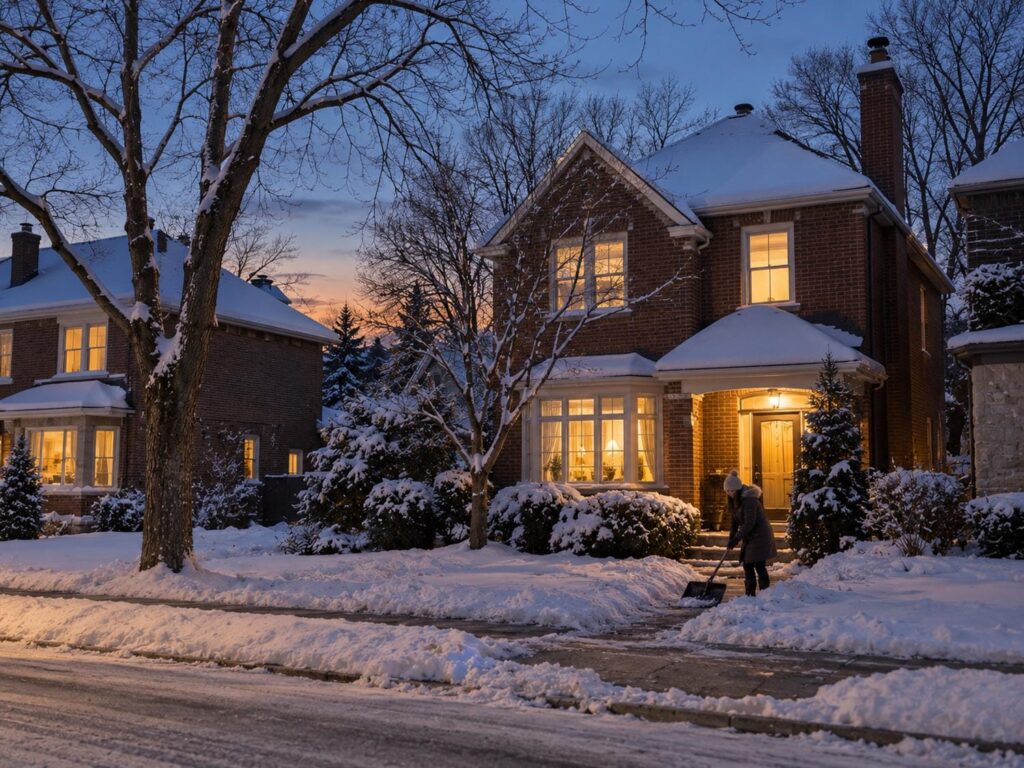
A detached Toronto house built in 1990 or later at about 2,000 square feet is the house Natural Resources Canada puts at a 65 gigajoule (GJ) annual heating load, a figure it publishes as a guideline for that house description rather than as a substitute for a heat-loss calculation on your own house. A gigajoule is a unit of energy equal to about 278 kilowatt-hours. Heated by a 96 percent gas furnace at the 1 October 2026 EGD rate for each cubic metre above the first 170 in a winter month, that house costs about $504 a year before HST and about $570 with HST.
Heating the same house takes about 18,056 kilowatt-hours of heat, which a heat pump draws as about 7,222 kilowatt-hours of electricity at an assumed seasonal COP of 2.5 and about 6,019 at 3.0. With HST, at 1 November 2026 electricity prices, the heat pump’s year costs:
- on the Tiered winter rate above 1,000 kilowatt-hours a month, from 1 November 2026, about $1,099 with HST at an assumed seasonal COP of 2.5 and about $916 at 3.0
- on Time-of-Use off-peak hours, from 1 November 2026, about $817 with HST at an assumed seasonal COP of 2.5 and about $681 at 3.0
- on Ultra-Low Overnight overnight hours, from 1 November 2026, about $445 with HST at an assumed seasonal COP of 2.5 and about $371 at 3.0
Priced entirely at the Ultra-Low Overnight overnight rate from 1 November 2026, the heat pump comes in at $371 to $445 with HST against gas at $570 on the 1 October 2026 rates, so the rate period where the arithmetic favours the heat pump favours it in dollars too, on the house more likely to match a typical GTA gas bill. Priced entirely on the Tiered winter rate above 1,000 kilowatt-hours a month from 1 November 2026, the same heat pump costs roughly $350 to $530 a year more than the furnace, with HST.
Burned in a 96 percent furnace, the gas for that detached Toronto house built in 1990 or later comes to about 1,815 cubic metres a year for space heating against its 65 GJ load, which sits under the 2,400 cubic metres Enbridge takes as typical annual use for a residential customer including hot water. If your house fits that description, your own gas bills should make that figure look recognizable. The same published guideline puts an older detached Toronto house, built before 1990 at about 2,000 square feet, at 95 GJ, and with HST, at 1 October 2026 EGD gas rates and 1 November 2026 electricity prices, that house costs about $833 a year on gas, against about $1,338 to $1,606 for a heat pump at the same assumed seasonal COP of 2.5 to 3.0 on the Tiered winter rate above 1,000 kilowatt-hours a month and about $542 to $651 on Ultra-Low Overnight overnight hours.
Three conditions sit under every one of those dollar figures. The gas figures assume a 96 percent furnace and the heat pump figures assume a seasonal average COP of 2.5 or 3.0, and both are stated assumptions run through arithmetic. No household heats entirely in one rate period, so each plan’s figure is a bounding scenario showing what that plan would cost if it applied to the whole season, not a prediction of anyone’s bill; a real Ultra-Low Overnight household pays the overnight rate for part of its heat and the on-peak rate for some of it. And the 2.5 to 3.0 band is an assumption read off the published example performance tables for two ducted units at the temperatures a Toronto winter mostly sits at, given a January daily average of -3.5°C at the Toronto City station in the 1991 to 2020 climate normals, not a published seasonal average.
Where the Heat Pump Still Comes Out Ahead
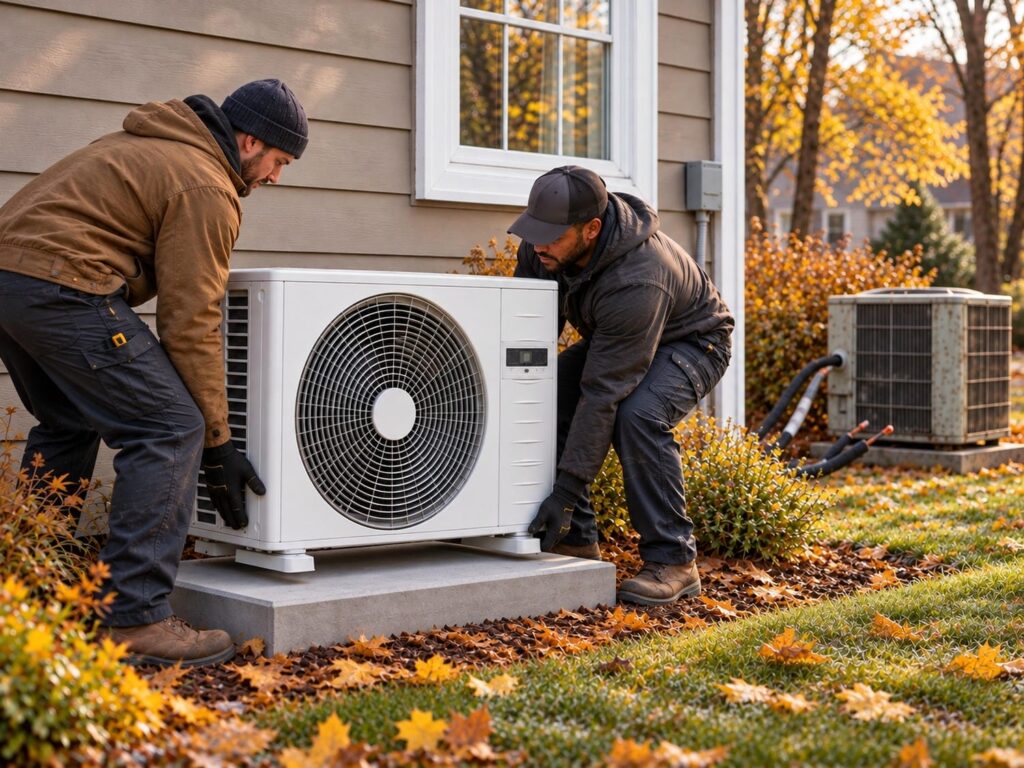
Running cost is one line in a decision with several. Over a whole winter on the Tiered and Time-of-Use plans, at 1 November 2026 electricity prices and 1 October 2026 EGD gas rates, the heat pump loses on running cost, and it can still be the better buy. Three situations decide it: the rebate, overnight heating on Ultra-Low Overnight, and a house where gas is not the baseline.
The Rebate Money Points at Heat Pumps, Not Furnaces
A cold-climate air source heat pump can draw up to $7,500 through the Home Renovation Savings Program, and the exact amount depends on the size of the unit and on the model appearing on Natural Resources Canada’s qualified products list. Save on Energy and Enbridge Gas run the program together, and a heat pump that is not cold-climate certified or not on that list draws nothing. Eligibility turns on the home as well as the equipment, so check the Ontario heat pump rebate in detail against your own house and model before you count the money in a quote.
The rebate money in Ontario right now points at heat pumps, not furnaces. A new high-efficiency furnace earns little or nothing on its own, so the heat pump starts several thousand dollars closer to the furnace once the rebate lands, even though it costs more to run over a whole winter on the Tiered and Time-of-Use plans. The program is running now, funded through to 2027, and rebate programs do close. If a heat pump is on your list, the rebate is a reason to move on it this season rather than next.
Overnight Hours on the Ultra-Low Overnight Plan
Overnight on Ultra-Low Overnight, from 1 November 2026, electricity costs about 6.16 cents a kilowatt-hour with HST on a Toronto Hydro bill. The bar in those hours is 2.0 against EGD gas rates from 1 October 2026, and published example figures for two specific ducted units, not a market survey, clear it down to about -8.3°C.
That suits a household that can carry most of its heating load through the night, which in practice means a reasonably tight building envelope and a thermostat strategy that leans on the overnight hours. A house that leaks heat fast cannot bank enough warmth overnight to coast through the day. It also means staying off electric heat on weekday evenings between 4 p.m. and 9 p.m., when that plan’s on-peak price of 37.7 cents from 1 November 2026 is the most expensive electricity on any of the three plans.
Homes Where Gas Is Not the Baseline
The running-cost case for gas assumes a live gas line and a working furnace. Where that is not true, the answer changes without any of the arithmetic changing. A house with no gas service compares the heat pump against electric resistance heat, oil or propane, and the heat pump wins easily. A house already replacing a failing air conditioner is the strongest case for a heat pump, because one outdoor unit does both jobs. A house with a dead furnace and a sound air conditioner is the case where gas usually still wins.
Before you ask for a quote, answer five questions about your own house, in this order:
- Is there a live gas line?
- Which electricity plan is the household on?
- What is the heat loss, and will the ducts move enough air at a heat pump’s lower supply temperatures?
- Is cooling being replaced anyway?
- What does the electrical panel allow?
The Third Answer: Keep Both and Let a Control Choose
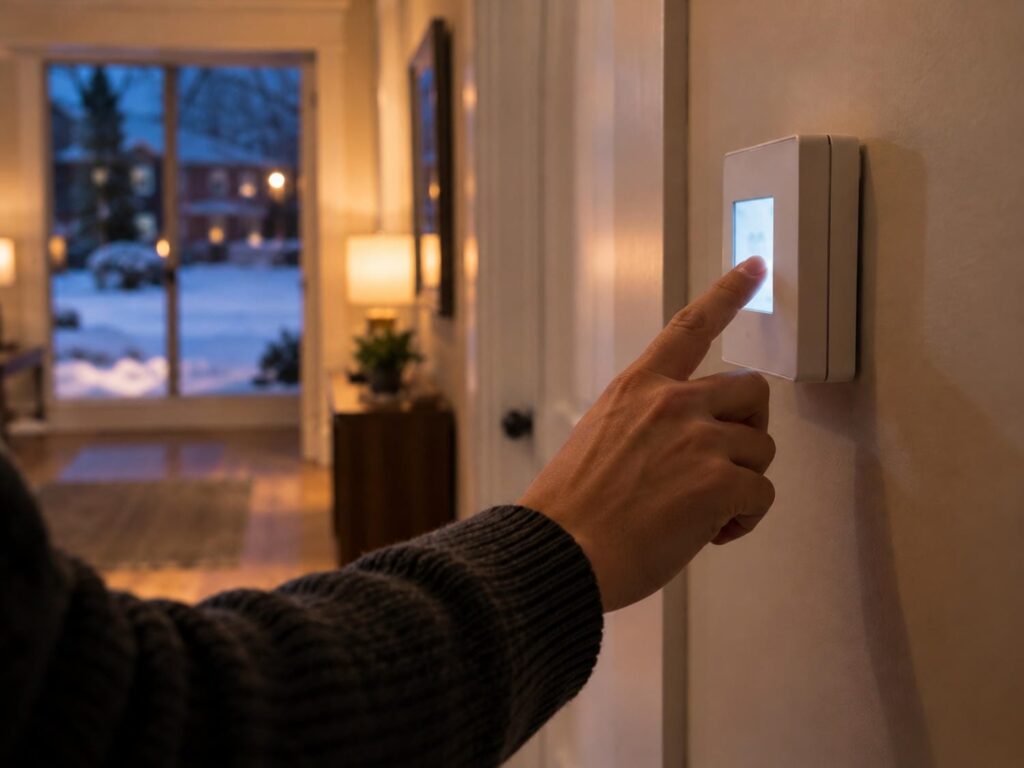
In a gas-serviced GTA home, gas versus heat pump is a false binary. At 1 November 2026 electricity prices and 1 October 2026 EGD gas rates, the break-even COP runs from 2.0 to 12.2 depending on the plan and the hour, so the cheaper machine changes with the clock and the weather. A dual-fuel arrangement keeps both appliances and lets a control decide which one runs, which is how a household captures the heat pump’s cheap hours and the furnace’s cheap hours in the same winter. A hybrid heat pump is a real third option, and how to set one up for a particular house is a question with its own answer.
Who Is Allowed to Do the Work, and the Cost Hiding in Your Panel
The two installations are not gated by the same authority, and the difference shows up in the quote. Gas work in Ontario must be done by a gas technician certified by the Technical Standards and Safety Authority (TSSA), working for a TSSA-registered contractor. Ask for the certificate, and confirm the registration before anyone opens a gas line.
A heat pump’s wiring falls under the Electrical Safety Authority: almost all electrical work in Ontario has to be reported to it by filing a notification of work, which should be filed before the work starts. If you hire someone to do it, the law requires a Licensed Electrical Contractor. A Certificate of Acceptance is issued once the work passes review, and it matters for insurance and resale. A heat pump also needs its own circuit, and where the panel has no room for one, the panel upgrade is the line item that moves the quote. Ask whether the quote in front of you includes it.
How Long Today’s Answer Holds
Electricity prices under the Regulated Price Plan now change once a year, on 1 November, so the set that took effect 1 November 2026 holds until 1 November 2027. Gas rates change quarterly, so the 1 October 2026 EGD schedule holds until 1 January 2027, and the gas side moves four times a year. The Ontario Electricity Rebate moves on its own schedule, set by the province, and it changes the all-in electricity price directly. The one change that would move the verdict hard rather than nudge it is the federal carbon charge on gas, which has been zero since 1 April 2025. Put back at its last rate of 15.25 cents a cubic metre, it would add about 55 percent to the price of each cubic metre above the first 170 in a month at the 1 October 2026 EGD rates, with or without HST. Re-run the comparison whenever any of these moves.
How to Run These Numbers on Your Own Two Bills

Five steps, with last winter’s gas bill and hydro bill on the table:
- Find the rate zone on your gas bill and confirm whether you are billed on EGD or Union South rates. The zone decides every gas line that follows.
- Add the per-cubic-metre gas charges on your own bill, including any cost adjustment, and leave out the fixed customer charge. At the 1 October 2026 EGD rates they come to 9.1080 cents for gas supply, 5.8452 for transportation and 12.8199 for delivery above the first 170 cubic metres in a month, which totals 27.7731 cents a cubic metre before HST, while the customer charge stays the same whichever machine heats the house, as long as the gas account stays open.
- Find your electricity price plan on your hydro bill. It is the single biggest lever you control.
- Pull last winter’s highest monthly kilowatt-hour reading and decide which tier or which hours your heat pump’s load would land in. On Tiered, every kilowatt-hour above 1,000 in a winter month bills at the Tier 2 price.
- Look up the break-even COP for your plan and its hours, then compare it against the performance table for the exact model you are quoted. Where that model’s COP at your winter temperatures sits below the bar, gas is the cheaper fuel in those hours.
Every heat pump publishes its own low-temperature performance table, and the lowest temperature it will keep running is on it, so ask for that table for the exact model you are quoted, for the house you actually have. A heating system is also sized against the coldest design temperature for your area, which your contractor uses in the heat-loss calculation, so ask to see the number they used.
Get the Arithmetic Before You Get the Quote
The number that decides this belongs to one house, one rate plan and one rate zone. A contractor who will not show you that arithmetic is guessing on your behalf. Before anyone talks price, ask for the break-even COP on your plan, the low-temperature performance table for the exact model, and the heat-loss figure behind the sizing.
Cozy World has been in business since 1991. We hold TSSA registration as a Heating Contractor and are gas licensed to do furnace installation, so when the numbers say gas still heats your house for less, a furnace replacement is work we carry out under that licence. There are no HVAC cost surprises with us either: the new system cost will be exactly as quoted.
If you want that arithmetic run on your own two bills, talk to us about your home. We will show you the working before we show you a price.
Frequently Asked Questions
Not over a whole winter on the Tiered or Time-of-Use plans: at electricity prices from 1 November 2026 on a Toronto Hydro bill and Enbridge EGD gas rates from 1 October 2026, a 96 percent gas furnace costs less to run on both. Published example figures for two specific ducted units, not a market survey, reach those plans’ lower bars, 3.6 to 4.8, only in mild weather and never reach 5.2 or 6.5. On Ultra-Low Overnight between 11 p.m. and 7 a.m., the bar is 2.0, which those figures clear down to about -8.3°C.
Ultra-Low Overnight, for a household that can carry most of its heating load through the overnight hours of 11 p.m. to 7 a.m., when electricity costs 3.7 cents a kilowatt-hour on the rate card from 1 November 2026. Against a 96 percent gas furnace on EGD rates from 1 October 2026, the bar in those hours on a Toronto Hydro bill is 2.0, and published example figures for two specific ducted units, not a market survey, clear it down to about -8.3°C. The catch is the plan’s weekday on-peak, 4 p.m. to 9 p.m., where the bar is 12.2.
No. Gas used since 1 April 2025 carries no federal carbon charge, and Enbridge’s EGD residential rate schedule effective 1 October 2026 still lists it at 0.0000 cents a cubic metre. A much smaller facility carbon charge stays folded into the delivery line, so the zero applies to the federal carbon charge itself. Any heating-cost comparison priced before 1 April 2025 includes a charge your bill no longer shows.
Up to $7,500 for a cold-climate air source heat pump through the Home Renovation Savings Program, which Save on Energy and Enbridge Gas run together, and the exact amount depends on the size of the unit and on the model appearing on Natural Resources Canada’s qualified products list. A heat pump that is not cold-climate certified or not on that list draws nothing. The program is running now, funded through to 2027, and rebate programs do close. Eligibility has its own conditions, so confirm your home and your model qualify before you count the money in a quote.
No. The Canada Greener Homes Grant has closed. The live money for a heat pump in Ontario is the Home Renovation Savings Program, run by Save on Energy and Enbridge Gas. There is also a federal affordability program aimed at lower-income households, delivered through provincial partners, so check whether your household qualifies before you assume the provincial rebate is all there is.
Recent Posts
Ready to Get an HVAC Service Quote?
Whether you have questions, need assistance, or want to schedule a service, we're here to help. Don't hesitate to contact us anytime.
