
Single-Stage vs Two-Stage vs Modulating Furnace: Which to Choose?
October 13, 2026 | Category: Furnace, Installation, Replacement

A single-stage furnace has one firing rate: full output or nothing. A two-stage furnace adds a lower rate for ordinary winter days and keeps the full rate for when the house falls behind. A modulating furnace works at points across a range instead of switching between fixed ones. That is the whole of the single-stage vs two-stage furnace question, and the modulating option sits at the far end of it.
Here is the part the quotes rarely say out loud. The price step mostly buys comfort and quiet, not a smaller gas bill, and a good share of what gets credited to the burner belongs to the blower beside it. Worth real money to some houses, almost nothing to others. If you are pricing a new furnace installation this week, the honest frame is comfort first, with a modest energy component attached.
What a Single-Stage, Two-Stage and Modulating Furnace Each Do
All three are sized for the same cold night, and all three spend almost the entire season needing far less than that. What separates them is how finely each one can turn itself down. That shows up in how the house feels through January rather than in what the meter records.
The Single-Stage Furnace: One Rate, On or Off
One firing rate, full output or nothing. The burner lights, the supply air comes out hot, the thermostat is satisfied in a few minutes, and everything stops. The house drifts back down, and it starts again. It is a sound machine, and the baseline the other two are priced against. One thing it cannot become is staged. Staging lives in the gas valve, the inducer and the control board, so nobody adds it to the furnace already in your basement. If you are asking whether yours can be upgraded, you are asking about your next furnace.
The Two-Stage Furnace: A Lower Rate and a Full One
Two fixed rates, and the furnace picks one. The lower rate handles ordinary winter weather, which is most of the weather a GTA house gets. The full rate is there for the nights the house starts falling behind. Natural Resources Canada illustrates the pattern with a two-stage furnace firing, for example, at 60 percent and 100 percent of its rated capacity. That is an example of how staged equipment fires, not a rating of any appliance, so treat it as the shape of the thing rather than as a number to expect on your quote.
The Modulating Furnace: A Range Instead of Steps
A modulating burner works at points across a range rather than switching between two fixed ones. The same federal guidance illustrates a modulating unit firing at any point from 60 to 100 percent, and a three-stage unit at 60, 75 and 100. Modulating equipment always arrives with a blower that can vary its speed, because firing rate and airflow have to move together. Drop the flame and leave the fan at full speed, and the air at the register turns cool and drafty. Marketing commonly promises deeper turndown and finer steps than that example shows.
The Two Things a Quote Calls Two-Stage
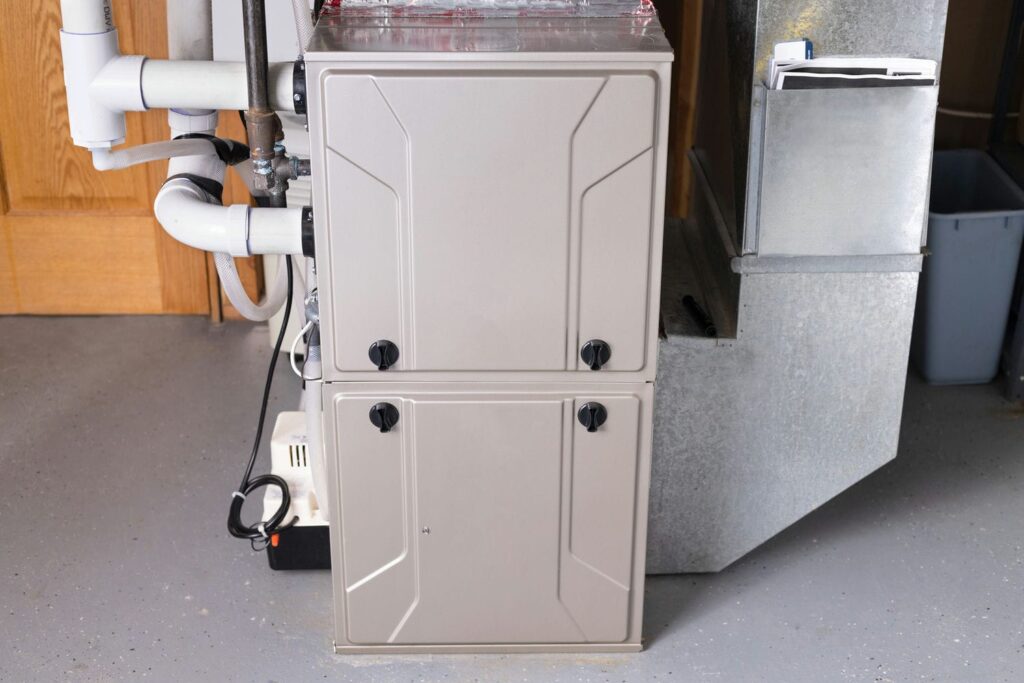
Two separate attributes get sold under one word. The burner, which is about gas. The blower, which is about air, noise and electricity. Each one routinely takes credit for the other’s work, and that is how a large price gap ends up resting on a single line of a quote.
The Burner Is About Gas. The Blower Is About Air, Noise and Electricity
The burner decides how long the furnace runs and how steadily the air is heated. The blower decides how quietly it runs, how steadily that heated air reaches the far rooms, and whether the fan keeps circulating once the burner shuts off. Heating the air and delivering it are two different jobs, and a quote that says two-stage has described only one of them. They are listed as separate fields on a specification sheet and set by two separate numbers in the federal efficiency rules. So ask which of the two a quote is charging you for.
Two Spec Fields, Read Them Both
Lennox publishes two Elite models at the same efficiency and the same Two-Stage heating stages value. The only field that differs is the blower motor: one carries a variable-speed blower, the other a constant-torque one. Same staging, same page, and both clear the Canadian efficiency floor. The specifications run the other way too, pairing a single-stage burner with a variable-speed blower on a model rated below 95 percent that an ordinary Ontario home cannot use, which proves the combination is buildable. Not every model in a catalogue is sold here, so ask which ones your installer stocks for the GTA. Across those pages the letter in the model number tracks the blower, not the staging, so read both fields.
Quiet Running and Air That Keeps Moving Belong to the Blower
Ultra-low continuous fan, enhanced humidity control, and filter and humidifier compatibility are listed features right across the published lineup, including on the single-stage models. Continuous low-speed circulation is a blower and controls feature, so nobody should pay a staging premium to get it. A feature list shows what is offered across the range, not that two units perform the same. If quiet running is what you are buying, make the quote answer it on the blower side.
The Blower You Pay Extra For Also Runs Your Air Conditioning
Count the months each half of the premium actually works. The burner stops mattering in April and does nothing until the first cold night in October. The fan works all summer, because air conditioning is delivered through it. So the quiet operation and the even delivery you paid for on the blower side earn their keep in both seasons. The staging premium is a winter-only purchase.
Single-Stage vs Two-Stage vs Modulating Furnaces Compared
All three burn gas, and all three will heat the same house. The differences that cost money sit beside the burner: the blower that comes with each type, and the control that runs it. They also arrive with different numbers of parts and different expectations about the thermostat on your wall.
| What You Are Comparing | Single-Stage | Two-Stage | Modulating |
| How the burner runs | One rate. Full output or off. | Two fixed rates. The lower one covers ordinary winter days. Federal guidance illustrates 60 and 100 percent. | Works at points across its range rather than switching. Federal guidance illustrates 60 to 100 percent. |
| The blower it comes with | Published specs show both: constant-torque, and variable-speed on a model below 95 percent that an ordinary Ontario home cannot use. | Sold both ways. Two models at the same efficiency and the same two-stage rating differ only in the blower. | Variable-speed, because firing rate and airflow have to move together. |
| What the evidence says about gas use | The baseline. | A national lab found two-stage alone does not save total energy at the house. The measured saving came with the motor paired to it. | Fires at a reduced rate for more of its hours. That shows up as steadier heat, not as a smaller gas bill. |
| Thermostat and controls | An ordinary thermostat. | Staged by the furnace’s own board from an ordinary thermostat, or by a staging thermostat and its wiring. Ask which. | Lennox sells its variable-capacity equipment as a matched system with its own communicating thermostat, so the two come together. |
| How much is in the cabinet | The fewest parts. | More: a two-rate gas valve and the control for it. | The most: a proportional valve, matched controls and a variable-speed blower. |
| The house it fits | Sound ducts, no overshoot complaint, an owner who wants the fewest parts. | A house that runs warm then cool around the thermostat, or rooms that never catch up, with an owner staying to live in it. | A load close to the capacity of the model you can buy, so the house spends real hours between the burner’s minimum and its maximum. Wanting the steadiest heat, and willing to buy a matched control. |
The blower and the thermostat decide most of the money, and both are things you can ask about before you sign anything. Underneath all of it sits one physical question that the price tags never raise: why does a furnace need to turn its flame down at all?
Why Turning the Flame Down Matters in a GTA Winter
A furnace is sized for a cold night that barely happens. It then spends its entire working life needing far less than it can produce. That gap between what the appliance can do and what the house is asking for is the whole physical case for being able to fire lower.
Your Furnace Is Sized for a Condition That Almost Never Arrives
Heating systems are sized to an outdoor design condition that is rare by construction. In an average year it holds for roughly 19 hours at the value ordinarily used to design heating systems, and roughly 8 hours at the stricter one. Everything else in the season is milder, so almost every hour the furnace runs, the house needs less than full output. A furnace that can only run flat out spends those hours overshooting and shutting off. Ask your installer which design value they used for your address, because that is the condition your furnace’s full output is sized for.
Most of the Winter’s Heat Is Not Delivered at Full Output
Under actual field conditions, the majority of a season’s heating load is not delivered at a furnace’s maximum input. Full fire is the exception rather than the working condition, and a single-stage furnace reaches it on every call for heat because it has nowhere else to go. Here is the catch. A furnace able to run lower spends the season in a gentler mode, which is a comfort outcome before it is an energy one. So nobody should expect staging to show up as a dramatic number on a gas bill.
A Modulating Burner Fills the Gap Between the Two Fixed Rates
A two-stage furnace has two choices. On a day asking more than its lower rate and well short of full output, it runs low and falls behind, or steps up and overshoots. A modulating burner can settle between those two points, and that span is the one place it does something a two-stage unit cannot. Every staged burner also has a lowest rate it will run at. On the mildest days the house needs less than that, and a modulating furnace cycles then, just as a two-stage one does. How much of your winter sits above that floor is why the minimum firing rate on the quote is worth asking for.
Single-Stage vs Two-Stage Furnace: Does Staging Cut Your Gas Bill?
This is the question every homeowner actually has, and the one most quotes answer worst. The answer first: a little, less than the quote implies, and the part anyone has measured belongs to the blower rather than to the burner.
What a Lab Found When It Separated the Burner From the Blower
Lawrence Berkeley National Laboratory asked this question directly in a 2006 study, using the equipment of its period. Its conclusion: two-stage technology by itself does not save site energy, which is the total energy used at the house. The electricity savings came from pairing two-stage furnaces with a brushless motor, and field studies confirmed them. Set against single-stage furnaces at the same efficiency level, the two-stage units showed about 3 percent less total site energy under one test procedure and almost no difference under the other. The saving the industry credits to staging was measured on the motor that came with it.
The Label Number Already Counts Part-Load Running
The way a furnace’s seasonal efficiency figure is calculated already assumes a staged unit runs differently from a single-stage one. So the part-load advantage is inside the number on the label rather than stacked on top of it. What an AFUE rating measures is a separate question, and the answer changes how you read two quotes side by side.
The Efficiency Rules Set Two Numbers, and Staging Is Not One of Them
For a gas furnace made on or after 3 July 2019, the federal efficiency rules set two requirements in the same row. One is a seasonal fuel efficiency figure. The other caps the electricity the furnace fan uses per unit of air it moves. Two numbers, two test methods. And nothing in the gas furnace provisions of those rules refers to staging, firing rate, two-stage operation or modulating burners. Ontario’s Home Renovation Savings Program, delivered by Save on Energy with Enbridge Gas, does not fund furnaces of any kind on either of its routes, so no rebate premium is waiting for a staged burner. Eligibility changes, so check the program’s own page.
What the Price Step Actually Buys
Staging is a step up in price, and how big a step depends on the series it comes in rather than on the staging alone. Get the two models priced side by side on one quote, with the thermostat in both, and the premium stops being abstract. The premium series bundles staging with the better blower and longer parts coverage, so a quote that hangs the gap on the burner has priced three things and explained one. The fuel saving from turning the flame down is small, and most of what people notice comes from the blower and from a furnace that fits the house. Buy staging for how the house feels, not for the gas bill.
What Staging Fixes, and What It Will Not Touch

Some comfort complaints staging genuinely fixes. Others belong to the ducts, and telling them apart before you sign is where the money is saved. Staging lets one furnace cover more of the season without overshooting, which helps because furnaces come in fixed size steps. It is not a substitute for getting the right furnace size for your house, which is a separate calculation that happens first.
The Comfort Complaints Staging Genuinely Helps
Two complaints respond to a lower firing rate. The first is overshoot where the thermostat hangs. The second is the rooms at the end of the longest runs, which never get enough minutes of airflow. Comfort here is about run length, not cycle counts. A furnace at a lower firing rate runs longer and stops less often, and that steadier run is what reaches the rooms the furnace has the hardest time serving. Federal guidance agrees, with a condition attached: where short cycling cannot be controlled and comfort has become an issue, consider a two-stage, three-stage or fully modulating unit.
The Complaints That Are a Duct Problem Wearing a Furnace Costume
A crushed duct, a starved return, a small register at the end of a long branch. None is a burner problem. Staging does not make a duct bigger, and a modulating furnace cannot find air that is not there. Low fire moves less air than high fire, so a staged furnace is gentler on tired ducts for most of the season. It still has to deliver full output on the coldest nights, and that is when your ducts get tested. The duct question does not go away because the furnace can throttle. When a brochure promises heat with no cold spots, that is a claim about the appliance, and a duct problem overrules it.
How the Furnace Is Set Up to Stage Decides What You Get
A staged furnace that was never set up to stage runs like a single-stage one, and nobody finds out, because the house still gets warm. On some installs the furnace’s own control makes the call; on others it is the thermostat and the wiring behind it. Which one you are getting, and what the thermostat costs, is worth settling before you sign.
A Two-Stage Furnace Can Stage Itself From an Ordinary Thermostat
On a two-stage furnace, the call to go to high fire can sit with the furnace’s own control board rather than with the thermostat. The board starts on low fire and steps up if the house is not satisfied within a set delay. The alternative is a staging thermostat with the extra wiring it needs, and on a retrofit the old single-stage thermostat and its wiring often simply stay where they are. The house gets warm either way, which is why this goes unnoticed for years. Ask which one your job uses, and get the answer in writing on the quote.
A Variable-Capacity Furnace Comes as a Matched System
Lennox states that its S40 thermostat works with its premium communicating equipment only, and that it works with Lennox variable-capacity equipment to deliver the highest level of system performance. The control is proprietary, the thermostat arrives with the system, and it is sold to work with that equipment rather than chosen off a shelf. That is not a reason to avoid modulating equipment. It is a reason to find out which thermostat is in each quote and what it costs, before you compare two prices.
Ask for the Minimum and Maximum Firing Rate in Writing
Every staged furnace has a minimum firing rate as well as a maximum, and both belong on the appliance’s rating plate. It is nameplate data, so the number exists even when the brochure omits it. Ask for both figures in writing on the quote, because the gap between them is what you are paying extra for. That range differs from model to model, and it is the specification that decides what staging actually buys you. A wide gap is worth money on a house that spends real time inside it, and little on a house that never asks for anything in that band.
Humidity, Filtration and the Fan That Runs Between Cycles
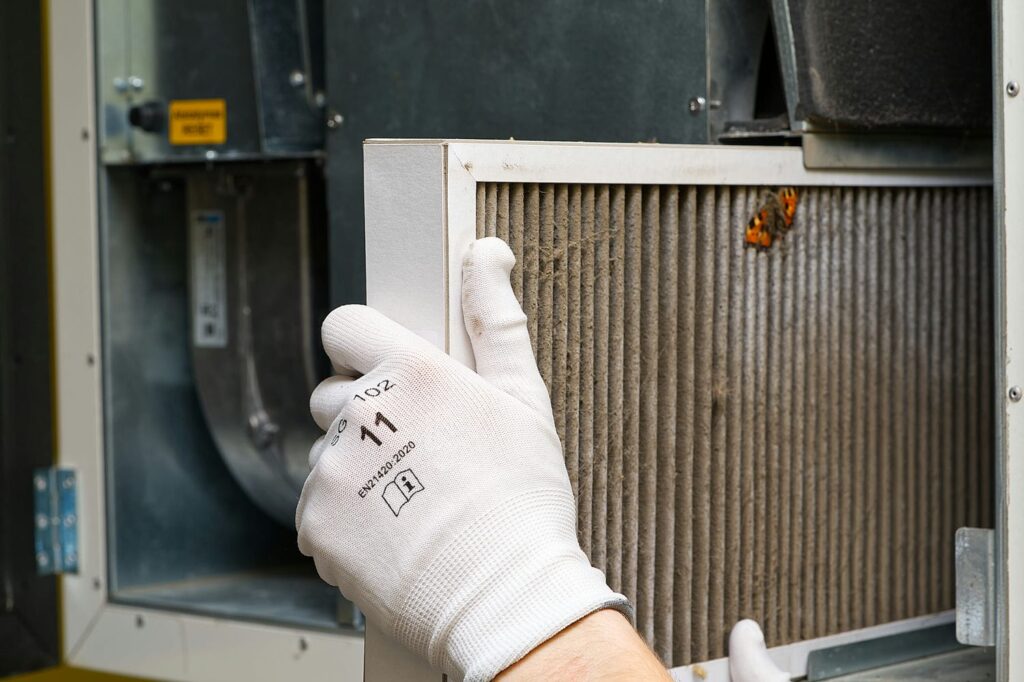
Longer, lower-rate runs change two things a homeowner notices in January. One is how well a humidifier keeps up. The other is how much air crosses the filter. In both cases the furnace may not be where the money should go, which is worth knowing before the staging premium gets justified on either of them.
Longer Runs Help a Humidifier That Depends on the Fan
A bypass humidifier uses the furnace fan to move humidified air through the house, so its output is tied to how much that fan runs. More run time, more moisture delivered. A powered humidifier has its own fan and can circulate humidified air even when the heating system is off, which removes the dependency. So if dry air is the real complaint, the answer may be the humidifier rather than the staging, and it is the cheaper fix. Health Canada recommends keeping indoor relative humidity between 30 and 50 percent for moisture control. A whole-home humidifier is what keeps a house inside that range through a cold snap.
More Air Across the Filter, More of the Time
At a steadier, lower capacity, more air passes through the air filter. A filter only removes what reaches it, so whether this matters in your house depends on the filter you have, not on the burner. Continuous low-speed circulation is listed right across the lineup, including the single-stage models, because it is a blower and controls feature. If air quality is the goal, the money usually belongs in furnace filters and air purifiers rather than in the staging.
More Parts in the Cabinet: What Ownership Looks Like
More capability means more components. The question that follows the price is what those components cost you in year 9. Two things decide that, and only one of them is the staging. Neither is on the brochure, and both are answerable in a phone call.
Covered-Parts Terms Follow the Series, Not the Staging
On the published specifications, the premium series carries roughly 10 years on covered components, with the longest heat exchanger terms attached. The mid and entry series carry about 5 years on covered components, with an extended term available. It follows the series, not the burner, so a homeowner comparing a two-stage unit against a single-stage one is frequently comparing two different coverage terms without being told so. Ask for the covered-parts term on each model you have been quoted, and put the two numbers next to the two prices.
Ask What Is on a Local Shelf
A two-stage or modulating furnace carries more parts than a single-stage one, so there is more on it that can need a technician. What protects you is two things: the covered-parts term on the series you are buying, and an installer who stocks for it. Ask how long that term runs. Then ask whether the control board and the gas valve for that model sit on a shelf in the GTA. With no heat and a forecast below freezing, the distance to the nearest spare board is what you will actually feel. Ask which models your installer actually stocks for the GTA, too.
Which One Fits Your House
Five things decide this, and none is on the brochure. Whether your ducts can carry what the furnace moves. Whether there is a real comfort complaint, and which kind. How far your calculated load sits from the model you can actually buy. What thermostat is going on the wall. And how long you plan to stay, because comfort you will not be there to feel is a weak reason to pay a premium.
How Far Your Load Sits Below the Model You Can Buy
Furnaces come in fixed steps, so a load landing just above a step takes the next size up and runs further below full output all season than one sitting near the top of its step. That distance cuts both ways. A big distance means the house spends most of the winter at or under the burner’s lower rate. That is a strong two-stage case: low fire lands near what the house asks for. A small distance means more hours asking for rates between that lower one and full output, and that band is the only place a modulating burner does work a two-stage one cannot. A house with sound ducts and no comfort complaint gains least from staging wherever its load sits. There is nothing for the lower rate to fix.
Buy the Staging Your House Can Actually Use
Three answers, in the order most houses meet them.
- Single-stage when the ducts are sound, nobody is complaining about overshoot or cold rooms, the thermostat is staying, or the house may change hands in the next few years. Put the difference into the sizing and the install.
- Two-stage when there is a real complaint of the kind a lower rate addresses, the house overshooting and drifting back around the thermostat, or rooms that never catch up, and the ducts can still carry full output on the coldest nights. It is also the answer when the sizing forced you a step up. Confirm in writing how the staging will be controlled.
- Modulating when the two-stage conditions hold and your calculated load sits close to the capacity of the model you can buy, so the house spends a real part of the winter asking for more than the burner’s minimum and less than its maximum. That band is where a modulating burner earns its premium, and a house that never reaches it is paying for a range it cannot use. Go in with open eyes about the matched thermostat and the extra parts.
If the ducts are the problem, none of the three is the answer. The money goes to the ducts.
Get Both Models Priced Side by Side
The decision gets easy when the two models sit on one sheet of paper, with the same sizing behind them and the thermostat priced into both. That is a fair thing to ask any contractor for, and it is the next smart step.
Cozy World has been putting furnaces into GTA basements since 1991, from offices in Toronto, Richmond Hill and Burlington. We are an authorized Lennox dealer, which is why we can put the heating stages field and the blower motor field of two models next to each other instead of describing them. We have installed all three kinds into GTA basements and seen how each one lives in a house. On a high-efficiency furnace install there are no cost surprises: the new system cost is exactly as quoted.
If you have quotes in hand and want them read side by side, book a furnace consultation and we will go through both.
Frequently Asked Questions
No. One word describes the burner and the other describes the blower, and manufacturers list them as separate fields on the same spec sheet. The published specifications show two models at the same efficiency and the same two-stage rating that differ only in the blower motor. They also pair a single-stage burner with a variable-speed blower, on a model rated below Canada’s 95 percent minimum that an ordinary Ontario home cannot use. Read both fields before you compare two prices.
Barely, on its own. A national laboratory study found that two-stage technology by itself does not save total energy at the house, and that the measurable saving came with the motor paired to it. The seasonal efficiency figure on the label also assumes a staged unit runs differently from a single-stage one, so the part-load advantage is already counted in the number you are comparing. Buy staging for how the house feels, not for the gas bill.
It depends which one you buy. A two-stage furnace can be staged by its own control board from an ordinary thermostat, or by a staging thermostat with the wiring that arrangement needs. A variable-capacity furnace is sold as a matched system with the manufacturer’s own communicating thermostat, so the control and the thermostat arrive together and are priced together. Ask which arrangement is in each quote and what the thermostat costs, before you compare the totals.
No. Ontario’s Home Renovation Savings Program, run by Save on Energy with Enbridge Gas, does not fund furnaces of any kind on either of its routes, so there is no rebate waiting on the staged burner. The federal efficiency rules do not reward staging either. They set an efficiency number and a fan energy number, and say nothing about how the burner fires. Eligibility changes, so check the program’s own page before you plan around it.
Low fire is the reduced firing rate a staged furnace uses for most of the season. Federal guidance illustrates a two-stage unit firing at 60 percent and 100 percent of rated capacity, and a modulating unit at any point from 60 to 100, as an example of how staged equipment fires rather than as a rating. The real range differs by model, and it is nameplate data, so ask for the minimum and maximum input in writing on the quote.
Ready to Get an HVAC Service Quote?
Whether you have questions, need assistance, or want to schedule a service, we're here to help. Don't hesitate to contact us anytime.
