
Why Does My Furnace Smell Like Burning? Normal Smells vs Warning Signs
November 13, 2026 | Category: Furnace, Furnace Service Repair

When your furnace smells like burning on the first genuinely cold night of the year, the smell is usually dust burning off hot metal, and it fades while the furnace keeps running. A sharp or acrid smell, rotten eggs, or any smoke sits in a different category, and none of those three waits. You are deciding one thing: ignore it, change a filter, or shut the furnace off and phone someone.
Each of those three choices belongs to a specific smell, and the smell itself tells you which one you are in. Every October our phones do the same thing, because the first cold nights put GTA furnaces to work for the first time since spring. Most of those calls turn out to be dust, and a few of them are the kind that need furnace repair the same day.
Most furnace burning smells on the first cold night of the season are dust burning off hot metal, and they fade while the furnace keeps running. A sharp, acrid or hot-plastic smell is different: shut the furnace off at its power switch and call a TSSA-registered contractor. Rotten eggs, sulphur or any smoke means everyone leaves the house first, and the call to the gas utility or 911 happens once you are outside.
Rotten Eggs, Smoke or Hot Plastic: Three Smells to Act On Immediately
Three smells end the diagnosis and start a procedure. Two of them get everyone out of the house. One of them gets the furnace switched off at its power switch. Minutes matter here. With all three, what you do in the next minute matters more than what the smell turns out to be.
Rotten Eggs or Sulphur: Get Out First, Then Call
Natural gas has no smell of its own. Before it reaches your house, Enbridge Gas adds a chemical called mercaptan so a leak smells like sulphur or rotten eggs. That is a different problem from a burning smell, and it has a different response.
Get everyone out, leaving doors and windows open behind you if you can do that safely, and once you are safely away, call the 24-hour emergency line at 1-866-763-5427 or 911. Those steps are Enbridge Gas’s instructions for a natural gas smell, and Enbridge Gas is the utility that serves the GTA.
On your way out, touch nothing: no light switches, no phones, no electronics, nothing that makes a spark, and no smoking. Do not go looking for the leak and do not try to fix it. Make the call once you are outside.
Smoke or Flame: Everyone Outside, Then 911
Anything visibly burning, or visible smoke from the furnace, means everyone outside and 911 from outside, and you do not stop to try to put it out. At that point you are not diagnosing a furnace. You are leaving a fire, and the only thing that matters is that everyone is out and the fire department is on the way.
In a GTA basement the common version is not the furnace itself. It is something stored against the cabinet or sitting on top of it that has started to char. Smoke is smoke either way, and the response does not change while you are inside the house.
Sharp, Acrid or Like Hot Plastic: Shut It Off at the Switch
Sharp, acrid, like hot plastic or like scorched wiring means something electrical inside the cabinet is overheating. A blower motor dragging on worn bearings and cooking its own windings smells like that, and so does a scorched relay. Shut the furnace off at its power switch and call a TSSA-registered contractor. This is not a wait-and-see smell, and a furnace that still makes heat while something inside it cooks is not reassuring.
Ontario utility guidance already uses this shape for gas appliances. When a gas stove burns with yellow flames, Enbridge Gas tells you to shut the appliance off and call a TSSA-registered HVAC contractor. Apply the same instinct to a furnace that smells of hot plastic.
Enbridge Gas does not repair furnaces, and it sends homeowners to a TSSA or HRAI contractor. We carry both registrations. Knowing what happens when you call for emergency furnace service makes the call easier.
When a Furnace Smells Like Burning Dust on the First Cold Night
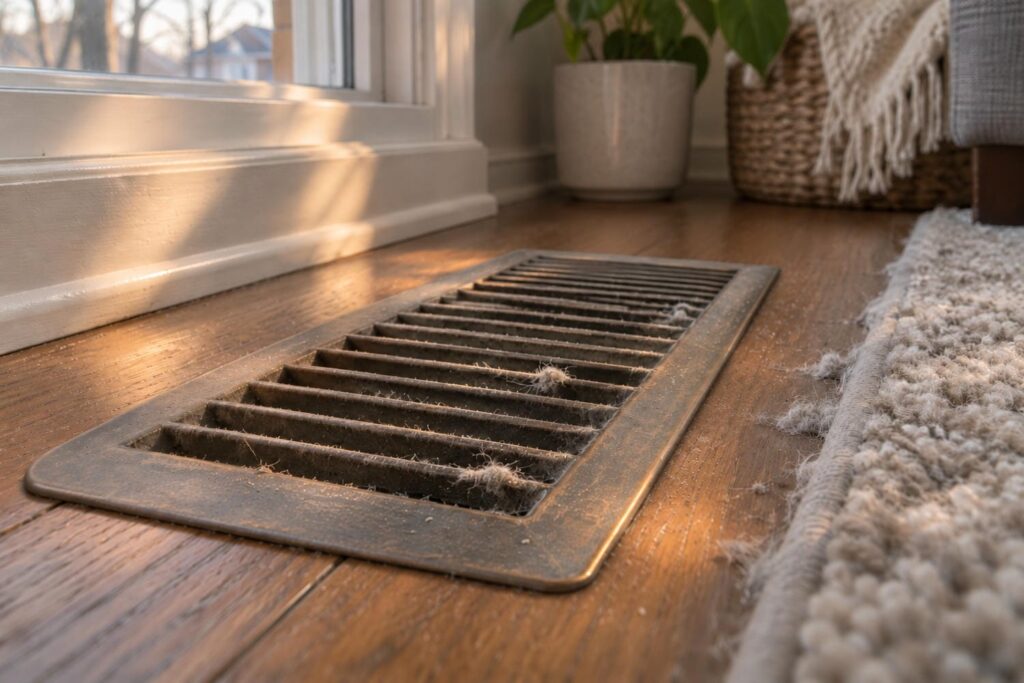
Dust, lint, pet hair and cooking grease settle on the burners and on the outside of the heat exchanger all summer. In October they meet hot metal for the first time since spring. It is a finite amount of fuel. It burns off and it is gone. On a heat pump paired with a gas furnace, the gas side may not fire until the first genuinely cold night, so a dust smell can arrive weeks after the heat came on.
How to Tell Dust Burn-Off From a Real Fault
Dust burn-off fades while the furnace keeps running, and it is weaker on the second cycle than the first. Watch the second cycle more than the first. If the burning smell comes back every time the burners light, or it is still there the next day, it is not summer dust and it needs looking at.
A dust smell on the first real firing of the season should be fading, not holding steady, by the time the furnace has run through a few cycles. So the question to take away is not how long it lasts. It is whether the smell fades, or comes back every time the burners light.
A Brand-New Furnace Smells Different
A brand-new furnace smells different on its first runs, and for a different reason. Manufacturing oils and protective coatings on the heat exchanger and the cabinet give off a hot-metal or faintly oily smell as they cook off. That is not summer dust, and a new unit has not had a summer to collect any.
The same behavioural test still applies. It should fade across the first firings. If it holds steady or gets stronger, the call goes to your installer rather than to anyone else. On a first heating season after an install, raise it at the first service visit rather than waiting for next October.
Look at What Is Stored Around the Furnace
Before you blame the furnace, look at what is around it. A plastic bag, a cardboard box, paint tins, a stored tarp, insulation that slipped off a pipe: people use the furnace room for storage, and anything resting against a hot cabinet smells like trouble. Keep stored items away from gas appliances, and leave the furnace an adequate air supply.
This is the one cause a homeowner can usually find and remove themselves, and it is worth checking first. If something is actively charring or putting out smoke, you are not checking storage any more. Everyone goes outside and the call to 911 happens from outside.
Once the Emergencies Are Ruled Out, One Question Does the Rest
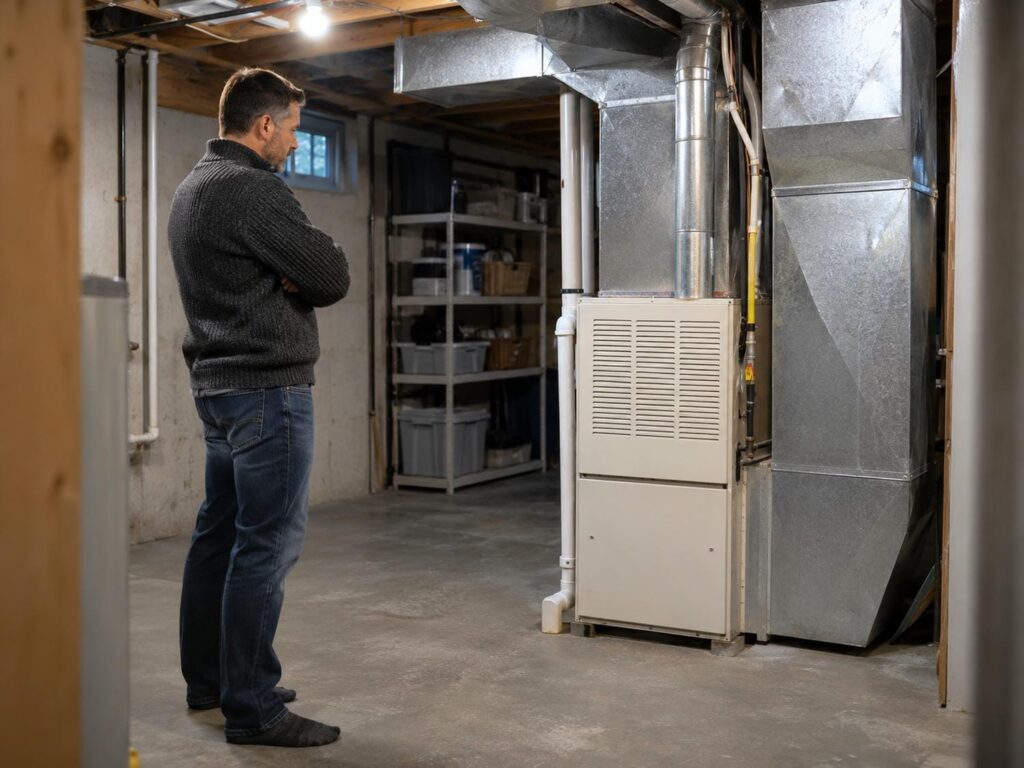
Does the smell fade as the furnace keeps running, or does it come back every time the burners light? That question works because of what dust is. A one-time burn-off has a shrinking supply of fuel behind it, while anything still being heated that should not be will make the smell again on every cycle. The question is for the dusty and hot smells only. It is not a test to run on rotten eggs, on smoke, or on anything sharp and acrid, which do not get waited out at all.
| Smell | What It Usually Means | What to Do |
| Dusty or singed, on the first cold night, and fading | Dust and lint burning off the burners and the heat exchanger after a summer of sitting | Let it run and watch it. If it fades and is gone the next day, no call is needed. If it comes back every time the burners light, treat it as a fault. |
| Hot or scorched, with weak airflow at the registers | The furnace is running hotter than designed because house air is restricted, often by a loaded filter | Turn the furnace’s power switch off before you open it, then clean or replace the filter. If the smell comes back, book a TSSA-registered contractor. |
| Sharp, acrid, or like hot plastic | Something electrical inside the cabinet is overheating | Shut the furnace off at its power switch and call a TSSA-registered contractor. Do not wait to see whether it clears. |
| Hot metal or faintly oily, on a brand-new furnace’s first runs | Manufacturing oils and coatings burning off new metal | Expect it on the first firings and watch that it fades. Call your installer if it holds steady or gets stronger. |
| Rotten eggs or sulphur | Mercaptan, the odourant added to the gas supply, which points at a possible gas leak rather than anything burning | Get everyone out, leaving doors and windows open behind you if you can do so safely. Touch no switches, phones or electronics on the way. Call Enbridge Gas at 1-866-763-5427 or 911 once you are outside. |
| Smoke, or anything visibly burning | Fire | Get everyone outside and call 911 from outside. Do not stop to put it out. |
| Musty, or like a dirty sock, and not burning at all | Biological growth on the indoor coil, which is an air-quality problem rather than a heat problem | Have the coil and the filter looked at. It is not an emergency, and it is not a burning smell. |
When a Dirty Filter Makes the Furnace Smell Hot
A filter packed with dust chokes off the air the furnace needs to carry heat away. With less house air moving across it, the heat exchanger, the wiring and the blower motor all run hotter than designed. Hot varnish and hot plastic have a smell. The tell you can use is a hot, scorched smell paired with weak airflow at the registers.
If the filter is dirty, clean or replace it, and turn the furnace’s power switch off before you open it up. That is Enbridge Gas’s instruction, and it is the one hands-on step a homeowner should take. Natural Resources Canada warns that a dirty filter can damage the system, and how often yours needs changing comes from your owner’s manual, not a rule of thumb.
When airflow stays restricted, the furnace’s own high-limit control opens and shuts the burners off to protect it. Resetting it again and again is not a repair. The filter your furnace actually takes is worth knowing before you buy another.
Carbon Monoxide: A Burning Smell Is Not How You Find It
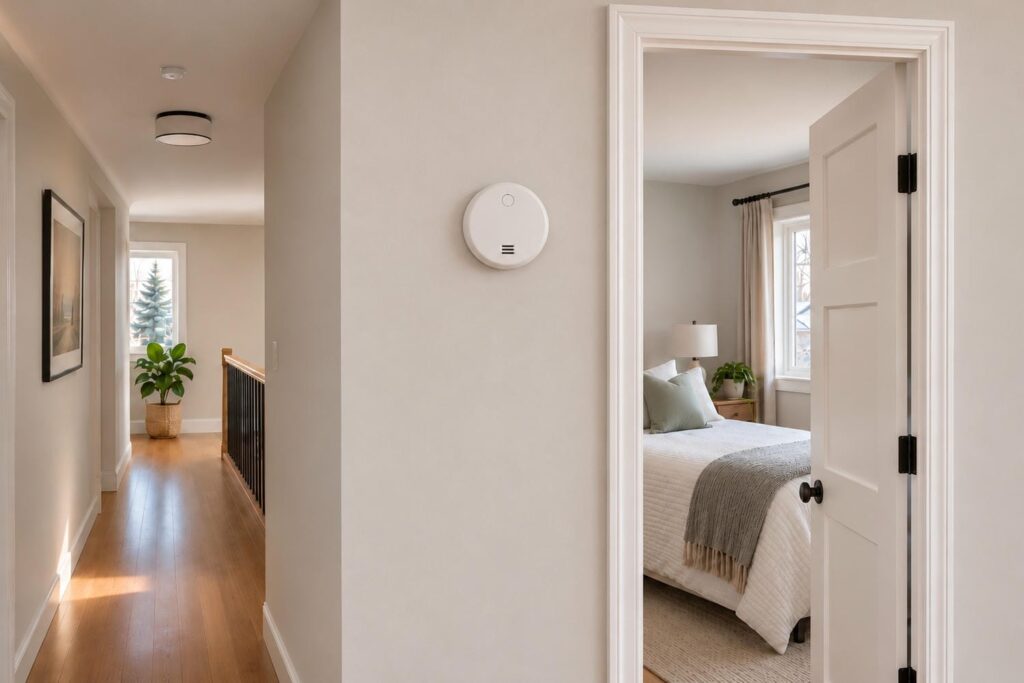
Carbon monoxide has no smell, no taste and no colour. A burning smell is not how you find it, and no smell at all does not mean you are clear. The furnace that produces a burning smell is the same appliance carbon monoxide comes from, so the two questions arrive together. It is the same appliance, two separate questions, and two separate tests.
Your Nose Will Never Detect Carbon Monoxide
Ontario’s safety material calls it the silent killer: invisible, tasteless and odourless, and detectable only with a carbon monoxide alarm. Two beliefs arrive with this. “No strange smell, so no carbon monoxide” is wrong. “A burning smell, so probably carbon monoxide” is wrong too.
Carbon monoxide comes from a fuel-burning appliance that is not working properly, or from a vent blocked so the exhaust cannot get out. A blocked exhaust vent raises the risk of carbon monoxide building up indoors, and in a GTA winter that is usually snow or ice over a sidewall vent. If the vent is buried, the furnace should not be running, and it needs a technician.
Ontario’s Carbon Monoxide Alarm Rules for Your Home
Ontario’s carbon monoxide alarm rules turn on three facts about your home, and most GTA houses meet at least one of them. If your home has a fuel-burning appliance, a fireplace or an attached garage, Ontario requires a CO alarm next to each sleeping area, and since 1 January 2026, one on every storey of the home, including storeys with no bedrooms on them. A gas furnace is a fuel-burning appliance, so a GTA home with a furnace in the basement is almost certainly covered.
When you buy one, choose an alarm tested and certified by CSA, ULC or another recognized certification body. As advice rather than law, federal guidance adds that the most important place to put one is in a hallway outside the sleeping areas.
What to Do the Moment a CO Alarm Sounds
A sounding carbon monoxide alarm is an evacuation, regardless of what anyone in the house can or cannot smell.
- Leave the home immediately and move to fresh air.
- Do not try to locate the source of the carbon monoxide.
- Once outside, call 911, the fire department or emergency services.
- Return only after the problem has been fixed by a professional.
Those four steps are Health Canada’s, in that order. Step two is the one homeowners break. The instinct is to go and check the furnace, which is the worst place to be standing while an alarm sounds. Do not wait to see whether anyone feels unwell first.
Why Symptoms Are Not a Substitute for an Alarm
Breathing carbon monoxide reduces your blood’s ability to carry oxygen, and it can affect you before you notice it. The symptoms are headache, nausea, dizziness, confusion, drowsiness, loss of consciousness and death. Those symptoms are described by concentration rather than by duration, so there is no scale or timeline for you to assess yourself against. Symptoms are not a diagnostic tool. An alarm is.
Without an alarm, the only way to know carbon monoxide is present is when the physical symptoms of poisoning appear, and by then it is too late. TSSA’s safety material is blunt: carbon monoxide is the leading cause of accidental poisoning death in North America.
Cracked Heat Exchanger: What You Cannot Confirm From the Basement Floor
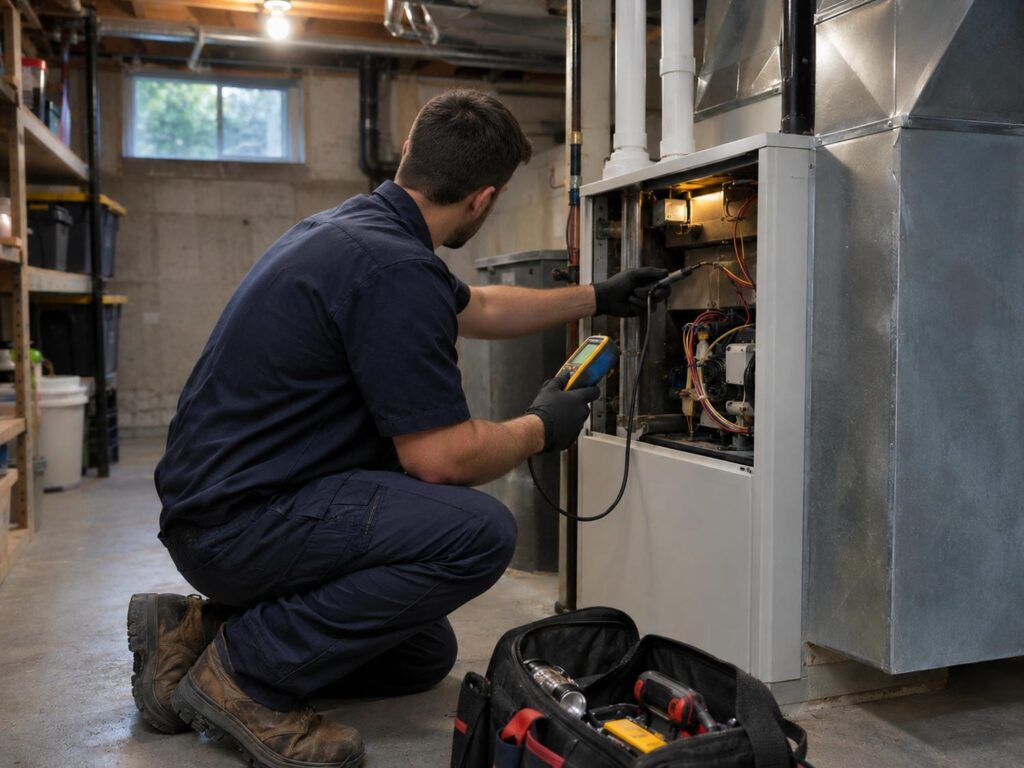
A cracked heat exchanger is not something you can confirm from the basement floor. The crack is often an internal split that only opens up once the metal is at operating temperature, which is why it takes a certified gas technician with instruments rather than a flashlight.
A smell, soot, the burners’ appearance and the flame’s behaviour are things people are told to watch for. None of them confirms a crack, and none of them rules one out. None is something to act on by itself. Your job is narrower: notice the symptoms, stop running the furnace, and have it looked at. Under Ontario law, furnaces and fuel-fired appliances have to be maintained by TSSA-registered contractors.
At the appointment the diagnosis comes off instruments: a combustion analyzer on the flue gases and a camera inside the heat exchanger. If the crack is confirmed, the next question is whether to replace a furnace instead of repairing it.
Who Is Allowed to Work on a Gas Furnace in Ontario
In Ontario this is licensed work. Furnaces and fuel-fired appliances have to be maintained by a TSSA-registered contractor, and a registered contractor has to employ TSSA-certified gas technicians. TSSA’s guidance on hiring a registered fuels contractor draws the line this way: the company holds the registration, and the person holds the certificate. Contractors are registered. Technicians are certified.
Ontario gas technicians hold a certificate of qualification, and the class of certificate sets what they are allowed to work on. You do not have to take anyone’s word for any of it. TSSA publishes a lookup of authorized heating fuel contractors, so you can check that a company’s registration is valid before anyone opens up your furnace. This is also why Enbridge Gas, which does not sell or repair furnaces, sends homeowners to a TSSA or HRAI contractor. We hold TSSA registration as a Heating Contractor and HRAI registration as an HVAC Contractor.
Why October’s Dust Smell Traces Back to a Skipped Pre-Season Inspection

Ontario’s own advice is to have fuel-burning appliances and vents cleaned and inspected every year before the cold sets in. Enbridge Gas tells Ontario homeowners to book that yearly inspection with a TSSA-registered HVAC contractor before the heating season starts.
A pre-season visit is when the summer’s dust comes off the burners and off the outside of the heat exchanger, and it is when a loaded filter gets found and changed. That is exactly the material that produces the smell in the first place. So the dust smell on the first cold night usually belongs to the inspection that did not happen last off-season. If the smell faded and nothing else turned up, a pre-season furnace tune-up and cleaning before the next cold snap is the move that keeps next October quiet.
Your Next Step Depends on Which Smell You Have
If the smell faded and stayed gone, the sensible next step is a tune-up booked before the next cold snap rather than during it. If it comes back every time the burners light, or it is sharp and acrid, the furnace stays off until somebody qualified has looked at it. That is not a next-month job.
Cozy World has worked across the GTA since 1991, from offices in Toronto, Richmond Hill and Burlington, and our installers are factory trained. For a smell that will not wait, emergency furnace repair is what you are asking for, and you can book a service visit with our team for the same day where the schedule allows.
Frequently Asked Questions
Yes, airing the room out is fine, and it does no harm to a fading dust smell. It will not clear any faster for the window being open, because the dust burns off at its own pace. The distinction that matters: if the smell is rotten eggs, or there is smoke, you are not ventilating a room, you are leaving the house and calling from outside.
That depends on whether you found the cause. If you traced it to something stored against the cabinet and took it away, that is solved, and it does not need a service call. If you never traced it to anything, the useful move is to mention it at your next service visit and name the night it happened. A technician checking a furnace with a reported one-time smell looks at different things than on a routine visit.
No, and the two do not overlap. A carbon monoxide alarm watches for carbon monoxide, and it will not pick up a natural gas leak. Your nose picks up a gas leak and will never pick up carbon monoxide. Neither one covers a burning smell. A quiet alarm tells you nothing about why the furnace smells hot, and a sounding one is an emergency of its own.
If you smell rotten eggs, there is smoke, or a carbon monoxide alarm is sounding, nobody is in the house tonight, let alone the furnace running. Sharp, acrid or hot plastic: no. The furnace stays off at its power switch overnight and gets looked at. Heat for one night is not worth it. A dust smell that is fading and weaker on the second cycle than the first: yes, and you can go to bed with it running. A hot smell with weak airflow: deal with the filter first, with the power switch off before you open it, and if the smell comes back, the furnace goes off. A working carbon monoxide alarm is what makes any overnight decision about a gas appliance a safe one, because an alarm is the test and a smell never is.
No. For a burning smell, the switch you want is the furnace’s own power switch, and that is the only thing you touch. A gas smell is a different situation entirely: if you smell rotten eggs, you do not go looking for valves, you get everyone out of the house and call from outside. Shutting off the gas supply is the utility’s job, not yours.
No, it makes the problem permanent. Everything the filter was catching goes straight onto the blower wheel and the outside of the heat exchanger, which is the dust problem with nothing left to stop it next year. If the filter is dirty, turn the furnace’s power switch off and then clean or replace it. Running it empty also puts that dust where nobody can reach it.
The smell itself is an irritant at worst, and a dust burn-off is not harming anybody. The real health question here is carbon monoxide, which has no smell at all, affects you before you notice it, and shows up as headache, nausea and dizziness that are not a reliable test. An alarm is the test, and a working one matters more than any smell you can describe.
Recent Posts
Ready to Get an HVAC Service Quote?
Whether you have questions, need assistance, or want to schedule a service, we're here to help. Don't hesitate to contact us anytime.
